After about 15 minutes of wandering the wood paneled corridors of McFungus mansion, you hear a scream. On the landing, Cynthia Sludgebucket has been squashed by a falling piano. It’s […]
After about 15 minutes of wandering the wood paneled corridors of McFungus mansion, you hear a scream. On the landing, Cynthia Sludgebucket has been squashed by a falling piano. It’s a stay a while, stay forever moment; one that ensures you’ll be thinking about The Detective Game long after you’ve figured out whodunnit. But pretty much all of Argus Press Software’s extraordinary adventure will stay with you. It unfolds like a novel, rain driving against the windows in the English countryside. There are eccentrics to meet and bombs under the bed. Your task? Find out who’s killing everybody before they kill you.
The plot, characters, coding and sound were all by British teenager Sam Manthorpe. “My earliest memories of computer games would be the arcade machines in the local chip shops: Space Invaders, Pac Man, Galaxians and Battlezone“, he tells Commodore Format from his present-day home in California. “The first game I played on a “home” computer was Galactic Hitchhiker, a text-based adventure game on a UK 101. I think, IIRC, the author’s last name was Knight (Matthew Knight? David Knight?). I loved that game. The UK 101 was an early, 6502 based, kit computer. My chemistry teacher, Mr Smith, had one in the classroom and would let us play on it during lunch break. “Us” was usually just me. That would have been around 1980/1981.”
CF: So that was your “aha” moment, then?
SAM: Yes. I knew I wanted to learn how to make games. I had done some BASIC, but quickly realised that BASIC was not going to cut it to write a proper game and that I needed to learn machine code. I saw people writing articles in computer hobbyist magazines where they would use a BASIC program to write machine code into the computer’s RAM and the games ran much faster and were more real time. As a kid I would meticulously type in all those hex codes to play the game and decided that I needed to learn what the mystical “machine code” was and how to write it.
I honestly can’t remember how I learnt the basics (maybe I bought a book?) but after a while I was writing machine code and even got my own game published in one of those magazines. I was thrilled. I must have been 13 or 14 years old. My Dad, realising I had a passion for it, promised that if I saved up enough money for a computer, he would pay half. And so I got two paper-rounds and in about a year I had a few hundred quid and he matched the rest and I got my first ever computer, a Commodore VIC-20.
My family moved to East Sussex and I started going to a different school in 1982. It was Uckfield Comprehensive. The school had a Computer Studies class (which was quite unusual back then) and so of course I took it. On the first day of class, our teacher, Graham Mills (to whom I am greatly indebted to) asked everyone to raise a hand if they had used a computer before. A few kids raised their hands. Then he asked if anyone had programmed in BASIC. A couple of kids raised their hands. Then he asked if anyone had programmed in machine code. I was the only kid to raise their hand. He took me aside and told me that I didn’t have to take his class but instead go to his office and disassemble the operating system of the school’s Commodore PET and explain how everything worked. I couldn’t believe my luck. I figured out the whole operating system and commented on it all. I learnt so much doing that. I went from having a basic understanding to having a pretty deep knowledge of how a 6502 based machine worked under the covers. I was ready to start making games.
“The teacher told me to disassemble the operating system of the school’s Commodore PET and explain how everything worked. I couldn’t believe my luck.”
– Sam on how he got his deep knowledge of a 6502 based machine
The VIC-20 was very limited, but I got a “machine code monitor” and started making some basic games with it. Then my friend up the road had just gotten a Commodore 64 and he let me use it as much as I wanted. And I did!
I wrote Out on a Limb (originally Jack and the Beanstalk) on his C64. I didn’t have an assembler, so it was all done by entering hex codes for the assembly and using graph paper to design the graphics (and then entering the hex code for those graphics).
CF: That’s mad. And it got published too! Was there much interest?
SAM: I think I only sent it to Anirog (because they were making a lot of games that I liked). After I sent the tape, about a couple of weeks later, as I was walking home from school, my Mum came out and shouted, “Sam, come quick, Anirog’s on the phone”. They said they wanted to meet me. My Mum took me to Horley and I met Roger Gamon, the co-founder. He was a lovely guy. He took me to their office, which was basically the ground floor of a suburban house. They had flight attendant tenants renting rooms upstairs (Horley is close to Gatwick Airport). I was awestruck, honestly. I met coders who had written some of the first games I’d obsessively played, and reverse engineered, on the C64 (Darrel Etherington, Jeff Gamon). I was rubbing shoulders with rock stars! And they were interested in publishing Jack and the Beanstalk!
They bought the rights to the game but wanted a few changes. Funnily, they wanted to change the name to Out on a Limb because they were worried about copyright infringement. This is hilarious because the main character in OOAL is basically Mario 🙂 Things were different back then, I guess. I told them that the changes might take a while and explained my development process (manually typing in hex codes) and they looked at me like “you’re insane!”. They gave me a proper monitor, a disk drive and an assembler. I was officially a professional coder!
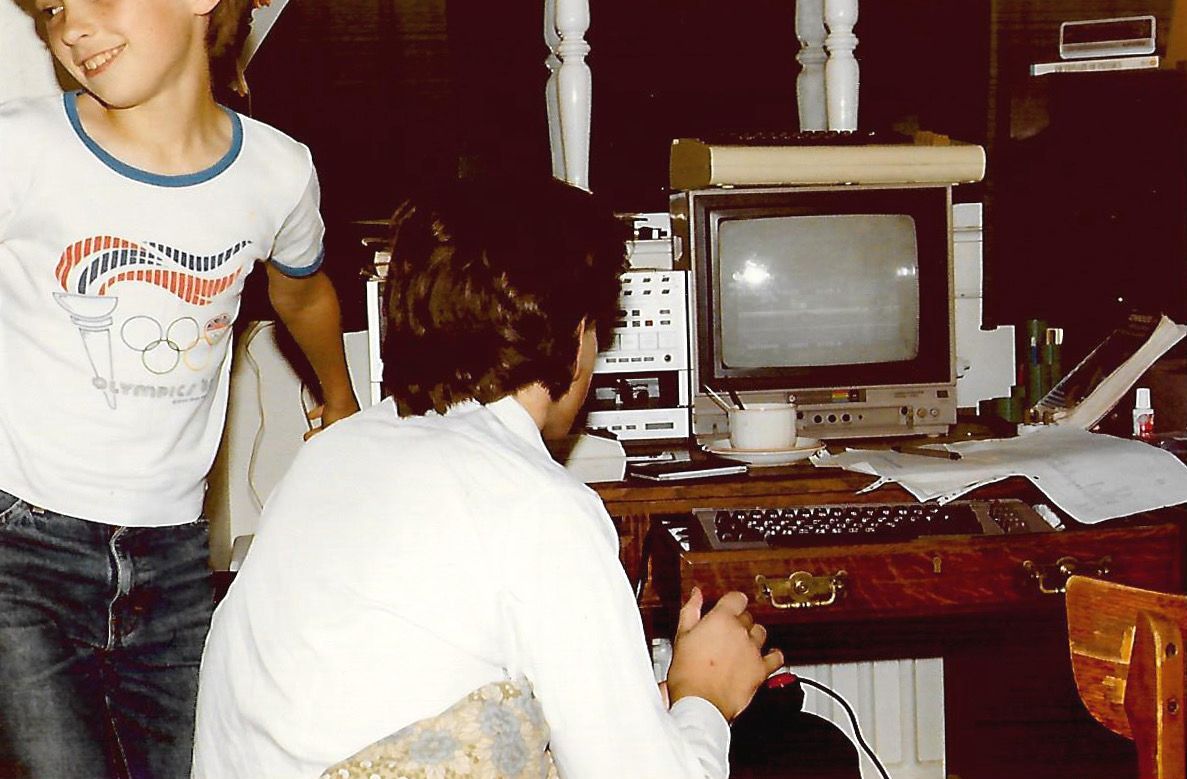
Sam (holding joystick) at the C64 he used to make The Detective Game. Brother Jack is on the left.Image copyright Sam Manthorpe.
By now Sam was doing A-levels. After the split of Anirog’s co-founders, Roger had formed The Magnificent Seven and planted a seed for what would become The Detective Game. It took Sam a year, for which he was paid £2,000. “They pretty much left everything to me, except that they hired a graphic artist to do the sprites of all the characters. His name is Paul Jay. A lot of the names of the characters came from one of my friends’ Dad. Everything else was me”. When complete, Argus Press Software published the game. “When Anirog split, Anil Gupta took the production and distribution with him and Roger the developers. I’m guessing that [Roger and The Magnificent Seven] had to find a third party for distribution”.
You play as Inspector Snide, summoned to the sprawling home of a rich man who’s died in mysterious circumstances. Once you’ve been shown to your room by the snooty butler, you’re free to roam the mansion and solve the mystery. If there’s anything of interest nearby, the border will flash. Fire brings up a bunch of icons that let you put evidence inside envelopes or perform other actions like question a guest.
It’s this eccentric cast of characters that really makes The Detective Game. You might think they’re talking nonsense at first, but each lunatic will drop a clue about the killer. There’s the dodgy Reverend Wrinklebottom and a saucy family cook with visibly bouncing boobs (Hilda Crumble was “100% Paul Jay”). Most memorable is the lunatic Major. “[He was] definitely heavily influenced by Fawlty Towers“, says Sam. “Funnily enough, a while back I watched an old film (re-watched, apparently) called Sherlock Holmes and the House of Fear – one of the Basil Rathbone ones. After watching it, I thought, OK, there is no way that film wasn’t a huge influence on The Detective Game.”
The comedy is offset by the game’s intense time-limit. Once you discover what’s left of Cynthia under the piano, it’s a cert that whoever’s killed McFungus isn’t going to stop. Sam told Commodore Format that the story was “sort of made up as I went along” with input from his siblings, but the narrative feels accomplished and intended to set you on edge. Its set pieces – like the falling piano – are cleverly executed by algorithm (“somebody told me it would be hard to do so I took it as a challenge”), adding to the tension. Sam spent a lot of time getting the rain and thunder sound right to set the bleak mood too. “These days you’d just use samples, but back then you had to use three oscillators.”
The Detective Game consistently scores over 8/10 on Lemon 64in modern times, and it was a hit when included on ZZAP! 64‘s August 1992 covertape. The detailed Paul Jay sprites and the blockbuster moments of murder are clearly wildly appreciated today. But in summer 1987 magazines gave it a lukewarm reception, pointing to a fiddly control system. Ultimately, you’ve got to find ten pieces of evidence and place them in envelopes before accusing the killer and finishing the game – but the menus can be a faff. “It’s very frustrating to use”, agrees Sam. “I wanted a control system like in Spy-vs-Spy (one of the best games ever written for the C64 IMHO), but at the same time I had been experimenting with Newtonian physics in terms of “feel”, so I stupidly tried to combine the two. Probably my biggest regret in that game. I did use it to much better effect in [his next game] Hyberblobthough.”
CF: They call Hyperblob the forerunner to Lemmings, y’know.
SAM: It’s the game that I’m most proud of because I thought it was an original idea and it was all mine (well, mostly – Steve Barret did the music). It’s also a simple, arcade-style game, a genre I’m very fond of (hence the two-player mode, the end of stage scores a-la Galaxian). I didn’t know about the Lemmings comparison until only a few years ago when I watched a YouTube video by Polaventris and was glad that somebody recognised that. I wrote the game in 6 weeks during Easter holidays at uni – you can tell, it’s a bit rough around the edges.
CF: And after that you went to uni, right? No more C64 stuff. What came next?
SAM: I started doing research work in telecommunications at Queen Mary College in London, then transferred to EPFL in Switzerland, where I did a PhD and also got married. Then we moved to California where I got a job at Silicon Graphics. Then I went to a start-up called Mirapoint. We lived in Prague for 4 years and then moved back to California, where we have been for 13 years now. I have two adult daughters.
CF: Have you ever been tempted back to the Commodore? There’s appetite for another adventure with Inspector Snide.
SAM: I think it’s incredibly cool that there’s so much interest in the 8-bit days. It was definitely a special time in terms of the ingenuity required to get something out of extremely limited hardware. If Electronic Arts wants to make a Detective Game II, feel free to pass on my e-mail address!
CF: We will! Thanks for talking to Commodore Format, Sam. You’ve seemed a bit surprised by The Detective Game’s legacy.
Yes, definitely surprised. I am in contact with a Swedish author who is writing a book inspired by the game, which really blew me away. It makes me feel really happy that there’s still so much love for it after so many years, hence the lengthy chat!
Regarding Roger: I remember going into the Anirog office one day and he told me that he had collapsed while crossing the road and had been diagnosed with a brain tumour. He died not long after that. It was really sad, he was a warm, kind man who had co-founded one of the biggest software companies of the 8-bit era in the UK and gave me my first break in the gaming industry. I’m pretty sure The Detective Game was his idea. CF 💣
The Detective Game. Coded 1986, released 1987.Reviews from June and July 1987 are listed here.If you want to play it, this guide has a lot of stuff you’ll need. It includes codes for accessing the safe (this was originally a neat part of the game’s copyright protection).



 Commodore Format Archive